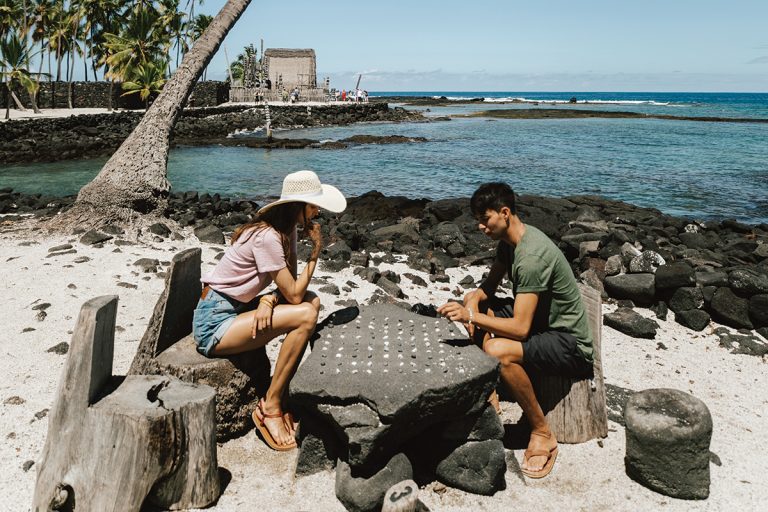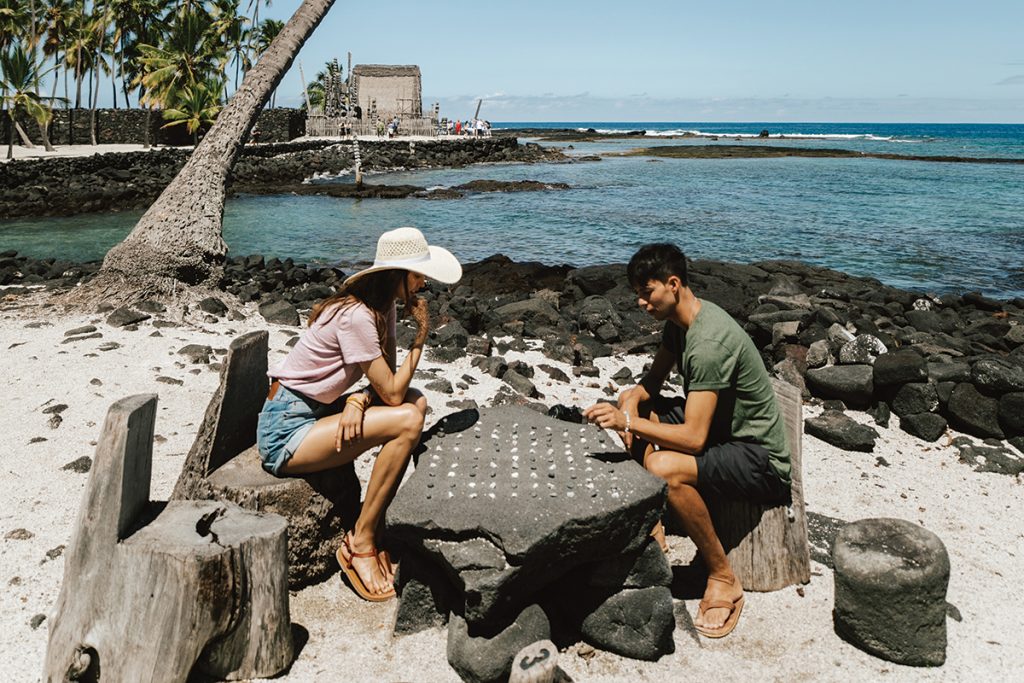
Once played by ali‘i and commoners alike, kōnane was a popular pastime in ancient Hawai‘i.
The strategy game requires players to think critically and consider the consequences of every move.
In ancient Hawai‘i, kōnane was played on a papamū, or game board, often made from large stones with shallow holes chipped into them to form a grid. The holes were filled with little black and white pebbles, or ‘ili‘ili, which served as the playing pieces. Papamū came in a variety of configurations, presenting players with new challenges. Players move in one direction at a time; they can move forward or backward, left or right, but not diagonally. To move, they must jump over their opponent’s piece and into an empty space, capturing the piece they jumped over. That enables them to not only remove their opponent’s pieces, but to block their future moves as well. The goal is to be the player who makes the final move.
Like many traditional practices and art forms, playing the game drastically declined following Western contact.
Fortunately, there is a growing community of kōnane players today. In February, eight contenders competed in the inaugural Ka Makou Kōnane Invitational Tournament at Bishop Museum on O‘ahu—the first of its kind in modern Hawai‘i.
In July, Andrew “Keahi” Castro, a student in Windward Community College’s Hawai‘iloa program, launched Likōnane (likonane.org), a free digital gaming platform that’s helping to bring the ancient game into the digital age.
With a background in mathematics and statistics, Castro built Likōnane over several years, working on it as a passion project. The site features tutorials, live multiplayer games, puzzles and an artificial intelligence opponent. Castro says he hopes to help players connect with each other through the site, but also with Hawaiian culture. “That’s why I tried to incorporate ‘ōlelo Hawai‘i throughout the website. Even if you’re there just to play the game, you get a bit of culture as well.”
Castro says that within four weeks, 400 people had logged on to play games. He says most users are from Hawai‘i, but some are from California, Washington and Texas—and as far away as Europe and South America.
“I think it’s really cool in this modern day and age that we can play this game with people around the world.”
This story was originally published in our 2026 FALL/WINTER issue, which you can buy here. Better yet, subscribe and get HAWAIʻI Magazine delivered to right to your mailbox.
Grace Maeda is the editor of HAWAIʻI Magazine.