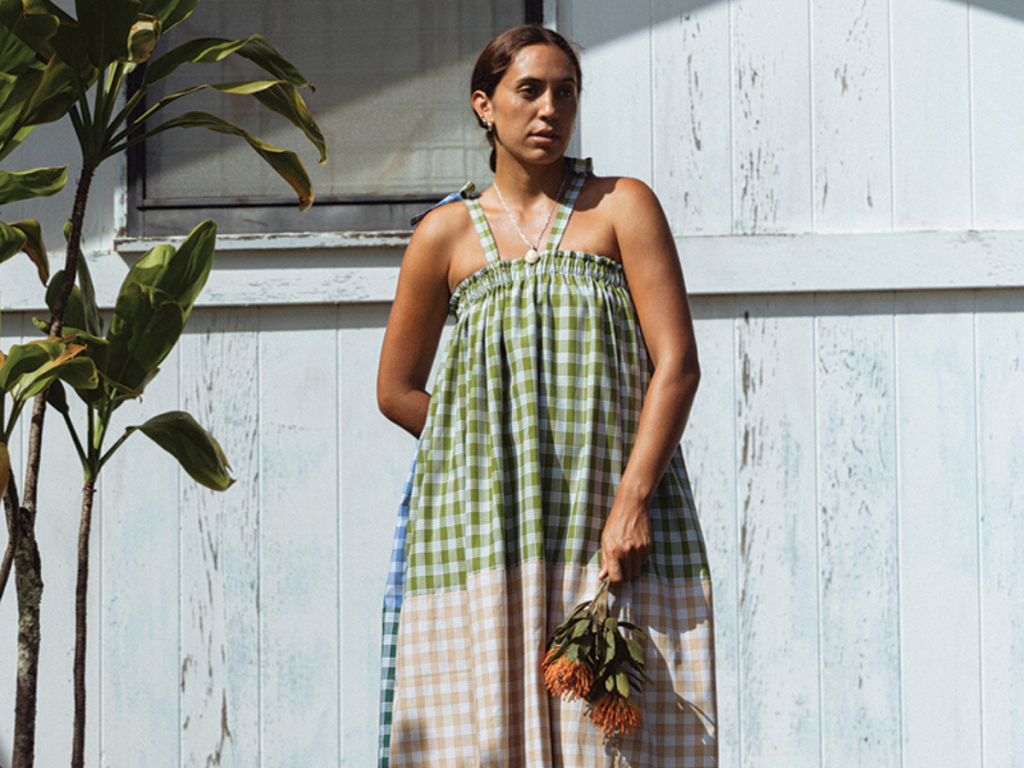
To the naked eye, it looks like plaid, but locals can spot palaka prints from miles away. Palaka, known for its signature white woven pattern atop a solid color—typically red, blue or green—has been a design staple of the Islands for generations. Today, local brands are elevating the pattern to connect with Hawaiʻi’s historical heritage, infusing palaka everywhere from tote bags and beach shorts to bow ties and musubi pouches.
The history of palaka is more than just a tale of a fabric, says University of Hawaiʻi professor of fashion design Andrew Reilly. The English translation of palaka means “frock,” and throughout the 1880s and 1890s, it described the rough-textured garments that British and American sailors wore at sea. The earliest mentions of palaka date back to the 1870s, when Hawaiian high chief Peter Young Kaeo, who was isolated in Kalaupapa with leprosy, wrote to his cousin Queen Emma that he had purchased cotton twill “to make me some frocks palaka.”
As Hawaiʻi’s demography evolved, so did the meaning of palaka. While the origin of the plaidlike pattern is still unknown, some historians say the print came from Christian missionaries who migrated from the continental U.S., as the “Cranston plaid”—nearly identical to palaka—was popular in New England around the same time. When thousands of immigrants arrived to work on Hawaiʻi’s sugar and pineapple plantations in the 1920s and 1930s, palaka became a work jacket for laborers and paniolo in rural fields. The rough-textured shirts and jackets were then produced in blue and white plaid, a woven fabric that combined Japanese immigrants’ indigo-dyed yukata material with plain white cotton. “Working with agriculture, [the palaka work jackets] really served as a denim to protect you,” says Reilly.
Over generations—from the plantation era to statehood to the Hawaiian renaissance of the 1970s—palaka has sustained its Hawaiʻi-grown heritage. “This is one of those things that has stood the test of time,” says Ro Oro, director of art and design at the travel bag brand Aloha Collection. Growing up, she remembers running around her neighborhood on the Windward Side of Oʻahu in palaka-patterned clothes handsewn by her mother. Over her seven years designing and developing patterns for the brand’s “splash-proof” bags, Oro always returns to palaka, which Aloha Collection has printed in teals, purples, beiges and hot pinks. Palaka is one of the brand’s most popular picks among locals and visitors alike, Oro says, because “it really just pulls on your heartstrings and brings you back to the core of Hawaiʻi.”
Matt Bruening, owner and designer of the namesake clothing and lifestyle brand, associates palaka print with red-and-white plaid matching family sets worn for family photos. Since 2018, Bruening has built a reputation producing palaka patterned bucket hats, totes, shorts and scrunchies in every colorway imaginable. In December 2025, Bruening showcased a collaboration with Hawaiʻi label Sig Zane Designs at a pop-up in Chinatown’s Kaiao Space. The collab—a matching collared shirt, pants and tote bag set of black and white palaka print that features illustrations of the bright yellow pāpiopio fish—sold out in one weekend. That nostalgia for Hawaiʻi memories doesn’t go away, he says, and with palaka being so ingrained in the culture of Hawaiʻi, infusing the pattern with contemporary fashion and design is the natural thing to do. And “it’s what people crave,” says Bruening.
This story was originally published in our SPRING/SUMMER 2026 issue, which you can buy here. Better yet, subscribe and get HAWAIʻI Magazine delivered right to your mailbox.