I’ve never fished in my life, so I’m a little nervous as I drive up to a fish farm on a Monday afternoon. It’s a holiday, so kids are out of school, and cars pull up one after another.
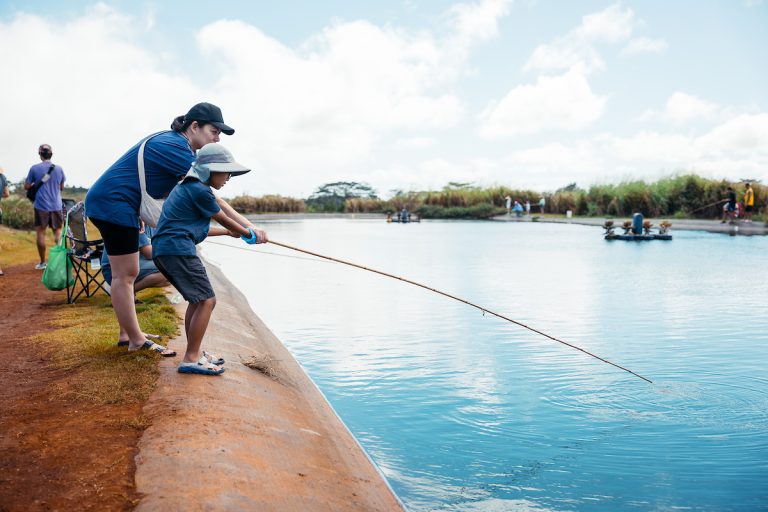
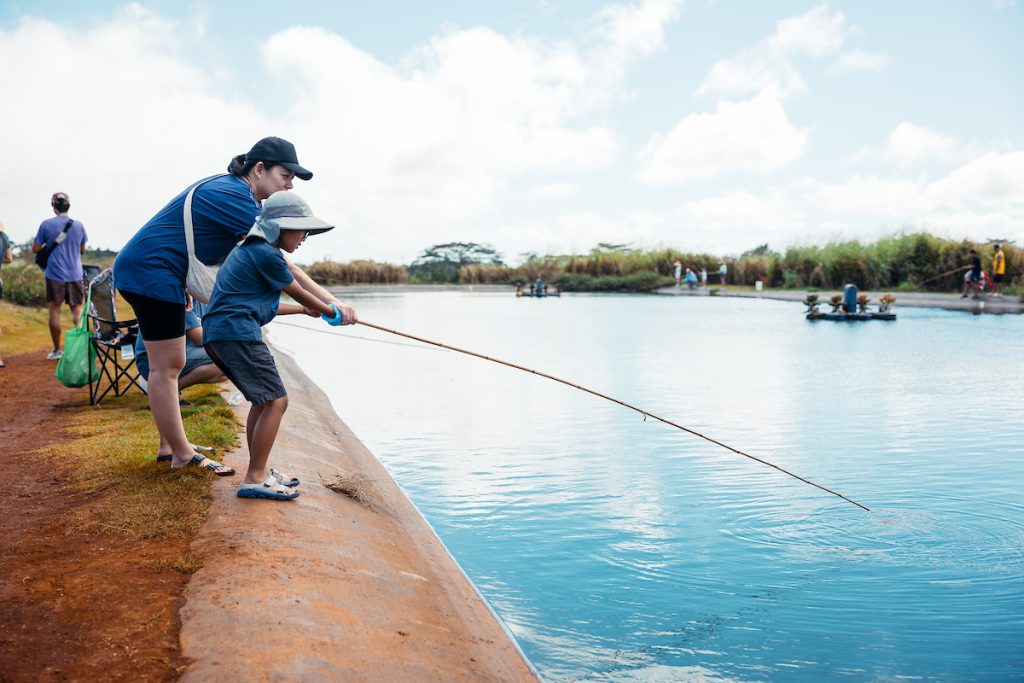
Families line a pond that’s 20 yards wide, 70 yards long and 7 feet deep, with plenty of tilapia and catfish inside. Some of the families have pop-up tents and even more have fold-up chairs; other folks just sit cross-legged at the edge of the pond, their lines in the water.
Ali‘i Agricultural Farms is a 68-acre estate in Central O‘ahu just outside Wahiawā. The farm’s primary crop is turf grass, but the owners also raise pigs, ducks, chickens and fish. Local families are lured to the farm daily for the chance to catch and release some of those fish, whether to take home or to eat on-site—the farm’s food truck will fry, steam or grill anything you catch.
When Malaysia-born See Thee, now 72, purchased the land in 2008, there was no running water. He dug a well and a 14-foot-deep reservoir, which he eventually stocked with tilapia to maximize the space. Friends would come by and ask if they could fish; they’d bring their kids and have a blast, so See began digging up ponds and in 2012 he opened them to the public.
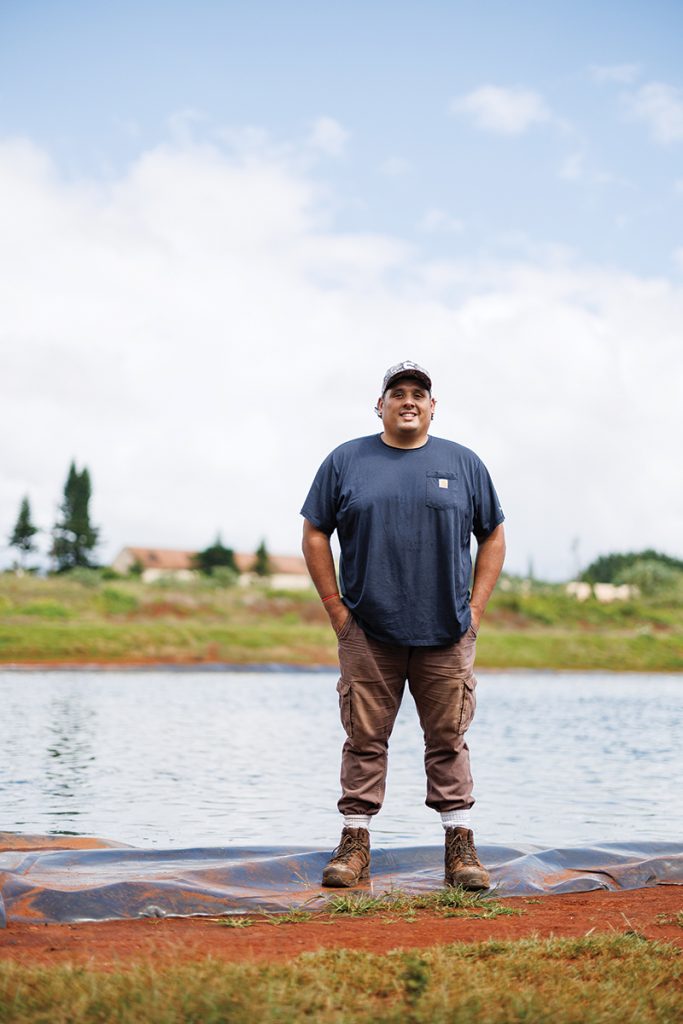
Photo: Aaron K. Yoshino
“Everyone has that first memory of catching fish,” says See’s son, Chris Thee. “Even though we’re surrounded by ocean, a lot of kids in Hawai‘i have never had the opportunity. So, we’ve created a family-friendly activity where, when you come to our ponds, it’s like 99.9% you’re going to catch something.”
Chris takes me for a ride in a golf cart to see his dad. We ride by duck and chicken coops, the piggery and slaughterhouse, and an orchard of lychee trees that are harvested-to-order every summer. We pass six more ponds, where baby tilapia and catfish grow before being hauled off to Chinatown where they’re sold wholesale.
We pull up to one of the ponds. See is sitting alongside it wearing a fishing hat and black rubber gloves. He is examining flapping fish in nets, either dropping them into another net or tossing them back into the pond if they’re not at least 1 pound. Two men place “the keepers” in a tub of water in the back of a golf cart and transfer them to holding tanks. Without looking up from his task, See asks me if I want to catch a fish. “I don’t know how,” I say. “I’ve never fished.”
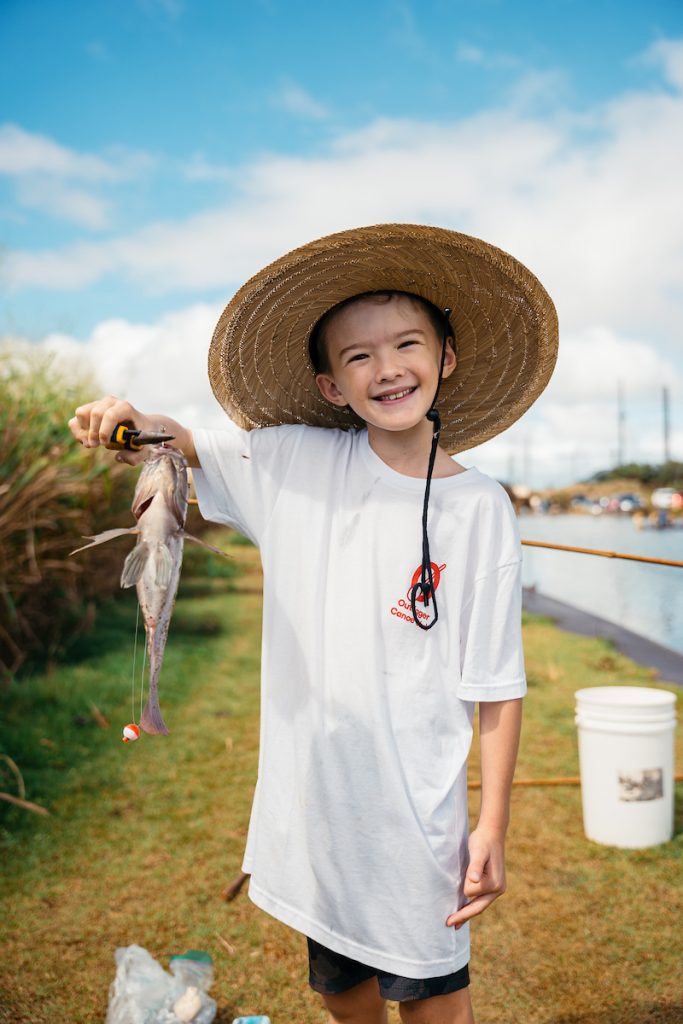
Photo: Aaron K. Yoshino
It’s time for me to try. Chris takes me back to the fishing pond and has me pick out a bamboo pole. There’s no reel, no complicated rigs, just fishing wire, a bobber and a hook. “I just dip this into the water and the fish hop on?” I ask. “Yeah, pretty much,” Chris says. He hands me a bag of what looks like goo. “Here’s your bait,” he says. “What is it?” He explains that it’s their “secret recipe,” a mix of mostly water and flour with “some other stuff.” He instructs me to grab a pea-sized portion of it, roll it around with my fingers and put it on the hook. “I can do this,” I tell myself.
I drop my line into the water and the bobber floats to the top. Other than moving it around or occasionally checking my hook to see if the bait is still there, I just stand and wait. And I watch: Families on either side of me are catching fish one after another, sometimes two at a time. Some fish are at least 3 pounds. I check my hook. Nothing’s hopped on yet.
So, Chris leads me behind the food truck, where there are three tanks. “Grab the net and scoop out whichever one you want,” he says. I choose a tilapia that looks to be about a pound. An auntie weighs my fish, and an uncle fries it up. While they work, I walk back to the pond and try again. About 20 minutes later, the uncle calls my name, and I’m handed a paper-lined tray holding a crisp, golden fish with a scoop of rice on one side and a paper boat of coleslaw on the other. There’s also a plastic ramekin of shoyu and two calamansi. I squeeze the calamansi over the fish and dig in with my fingers, pulling the soft, steamy flesh away from the bones and snapping off pieces of fried fins and tail to eat like chips. The fish is mild and tender, and the citrus gives it a nice tang. I devour it, sans shoyu.
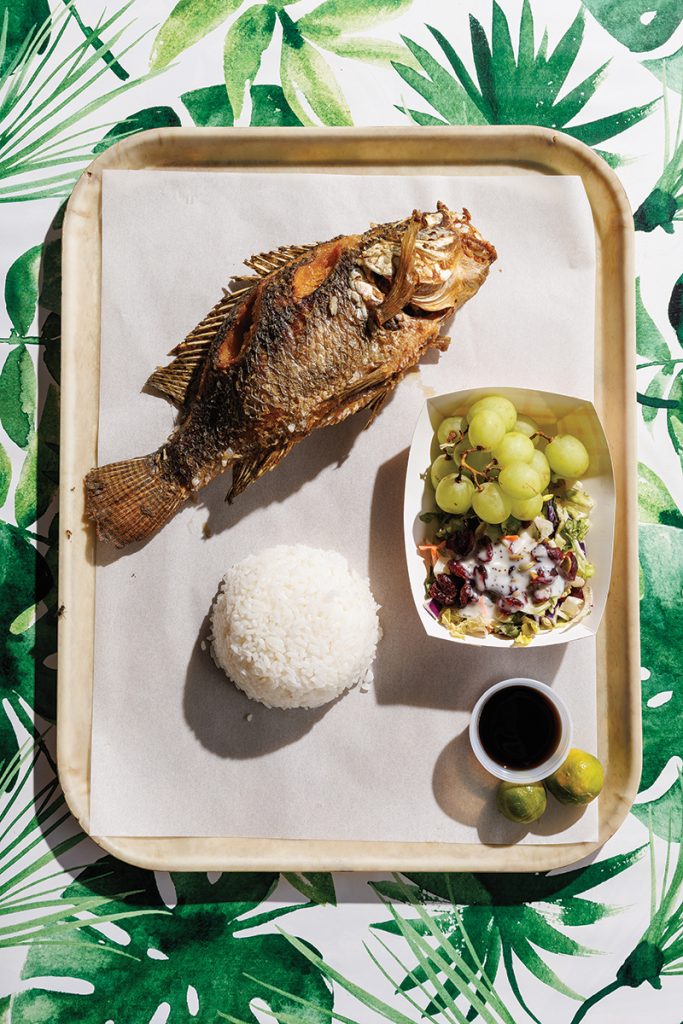
Photo: Aaron K. Yoshino
Two tables down, a dad and three toddlers huddle over trays of fish, picking at it and licking their fingers just like me. I remember learning to enjoy fish with my dad when I was about the same age as these kids, and I feel bad about the lousy reputation tilapia and catfish have had on O‘ahu. Some people here call them “mud fish,” because they can survive in muddy water. In reality, the fish is clean.
“We have elementary kids come out for field trips,” Chris says. “It’s really interesting to see that bad reputation [start to] change when they come here.”
The farm’s food truck has gotten so popular, some visitors skip the fishing and come just for lunch. Most customers order the fish fried. “That’s their favorite preparation,” Chris says. “There’s a large Filipino community here, but also Polynesians, Samoan, Tongans, Fijians. They all love tilapia. It reminds them of home.”
Ali‘i Agricultural Farms, 680 Whitmore Avenue, Wahiawā, (808) 690-0558, fishingfarmshawaii.com.
This story was originally published in our SPRING/SUMMER 2026 issue, which you can buy here. Better yet, subscribe and get HAWAIʻI Magazine delivered right to your mailbox.
Sarah Burchard is a frequent contributor to HAWAIʻI Magazine.