This story was originally published in our SUMMER Digital issue, which you can view here.
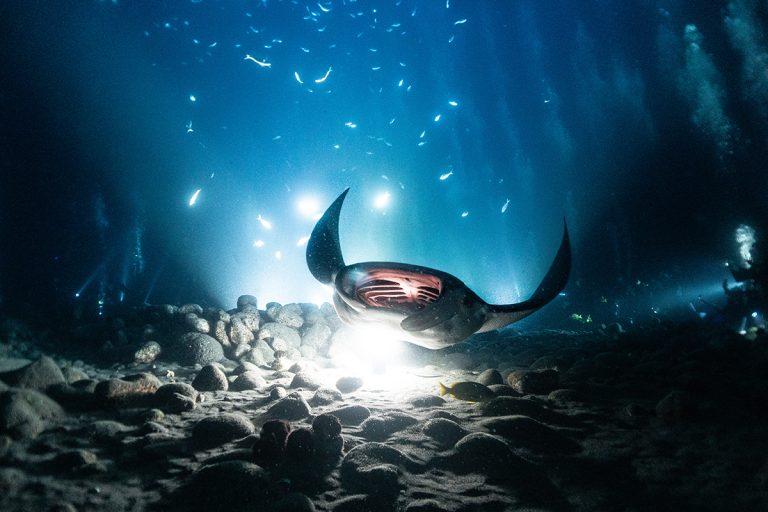
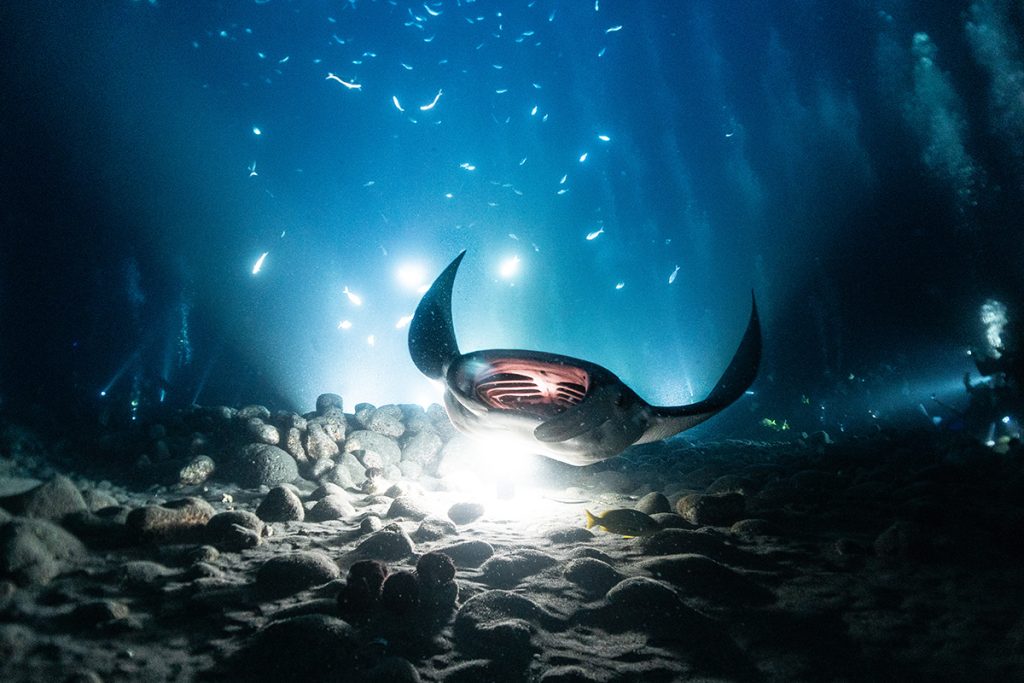
Under the ocean’s surface and beneath a starry sky, a manta ray with a 12-foot wingspan glides just below me. Its winglike pectoral fins propel it effortlessly through the waters off the Kona Coast.
More of these gentle creatures are drawn to the boat’s under-water lights, which attract microscopic zooplankton, their primary food source.
The Kona Coast is considered one of the best places in the world to swim with manta rays. Kona’s resident population can be seen year-round, thanks to nutrient-rich waters that provide a reliable food source. During nighttime snorkel and dive tours, underwater lights attract plankton, creating abundant feeding opportunities that manta rays return to night after night.
Most excursions begin around sunset and head to established feeding sites off the Kona Coast. Once guests enter the water, they hold onto illuminated platforms while manta rays glide toward the surface in search of plankton.
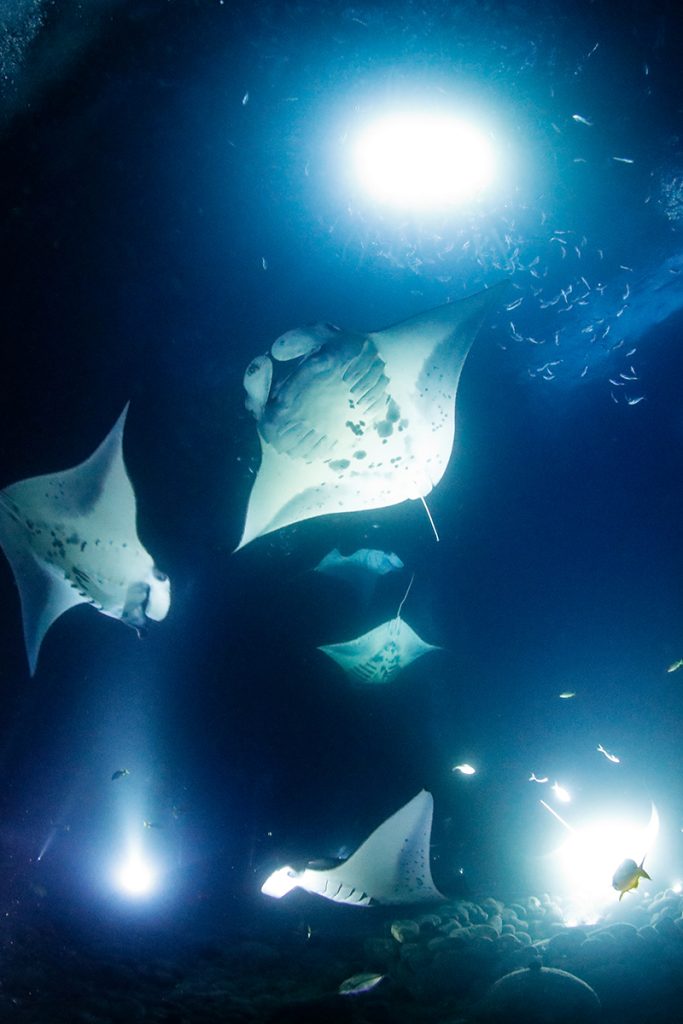
Photo: Getty Images/Xiaoyue Guo
Known as hāhālua in ‘Ōlelo Hawai‘i, manta rays are revered in Hawaiian culture and mentioned in the Kumulipo, the Hawaiian creation chant. Hāhālua are also regarded by some families as ‘aumākua, or ancestral guardians, believed to provide protection and guidance. With their calm demeanor and steady movements through the ocean, manta rays have become symbols of balance and grace.
Two species of manta rays are found in Hawai‘i: the giant manta ray (Mobula birostris) and the reef manta ray (Mobula alfredi). Giant manta rays can have wingspans of up to 26 feet, while reef manta rays typically span 10 to 18 feet across. Although giant manta rays are occasionally spotted off the Kona Coast, reef manta rays are most often encountered on Hawai‘i Island’s famed nighttime manta tours. Despite their impressive size, these creatures are remarkably gentle as they feed on tiny zooplankton.
Keller Laros, founder and director of the Manta Pacific Research Foundation, says these creatures are among the most intelligent fish. “They have a brain the size of a human fist,” he says. Manta rays also have the largest brain-to-body ratio of any fish. Research also suggests they may even be capable of recognizing themselves in a mirror. Like human fingerprints, Laros also explains that each manta ray has a distinct pattern of spots on its belly, which helps researchers identify individuals.
Manta rays are known to live long lives, with some documented to survive 40 to 50 years or more. The Manta Pacific Research Foundation identifies and tracks these animals throughout the Islands, maintaining catalogs for Hawai‘i Island, Maui and O‘ahu.

Photo: Getty Images/Coobrien
Laros has been diving with manta rays since 1991 while working as a dive instructor at Jack’s Diving Locker in Kailua-Kona. He founded the Manta Pacific Research Foundation in 2002, and one of its first major initiatives was advocating legal protections for manta rays. Those efforts became successful in 2009, when Hawai‘i made it illegal to kill or capture manta rays.
Today, the foundation conducts and collaborates on a variety of research projects. One study is analyzing DNA from manta rays across the Islands to piece together family trees. Laros says one question researchers are exploring is whether squadrons of manta rays have a social hierarchy, including an “alpha” male or female.
Beyond identifying and tagging animals, another team of researchers has been closely tracking their daily movements. A group followed a manta ray named Big Bertha and recorded that she traveled about 40 miles in 12 hours. Despite their ability to cover long distances, research indicates that reef manta rays rarely cross the channels between the Hawaiian Islands. One study estimates that only one male reef manta ray crosses the ‘Alenuihāhā Channel—the 30-mile stretch of ocean between Hawai‘i Island and Maui—every 50 to 150 years. The same study suggests only one female makes the crossing every 500 to 1,500 years. Researchers believe this is because reef manta rays spend much of their time in waters about 100 feet deep, while the ‘Alenuihāhā Channel plunges to depths approaching 7,000 feet.
Watching manta rays glide gracefully through the ocean reminds me why hāhālua have been revered for generations—not only as remarkable marine animals, but as living links between Hawaiian culture and the natural world.
Grace Maeda is the editor of HAWAIʻI Magazine.