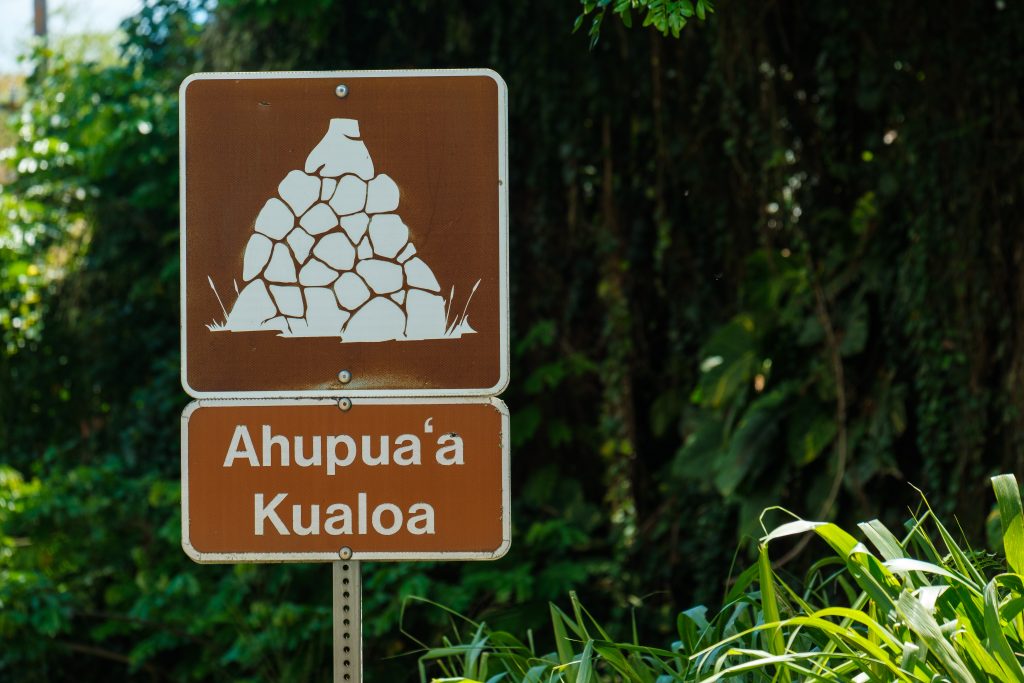
Most locals know the concept of the ahupuaʻa, a land management system that extends from mauka (mountains) to makai (ocean). About a decade ago, the Koʻolaupoko Hawaiian Civic Club installed signs marking the ahupuaʻa in the Koʻolaupoko district on Oʻahu—roughly Waimānalo to Kahuku. That inspired an islandwide program—a partnership between community organizations and the state—to identify the physical boundaries of Oʻahu’s traditional Hawaiian ahupuaʻa land divisions recognized by the Kingdom of Hawaiʻi. It’s a way to connect residents and visitors with their kuleana (responsibility) to be good stewards of the natural and cultural resources within these distinctive areas.
The original markers were stone ahu (piles or mounds), as depicted in the signs you see today, topped with a pig’s head in tribute to the chief. Those markers have all been lost, scattered or destroyed over the past 200 years. Currently, there are about 150 signs installed islandwide—the state Department of Transportation even added GPS to all the marker sites—across the six moku (districts) on Oʻahu.
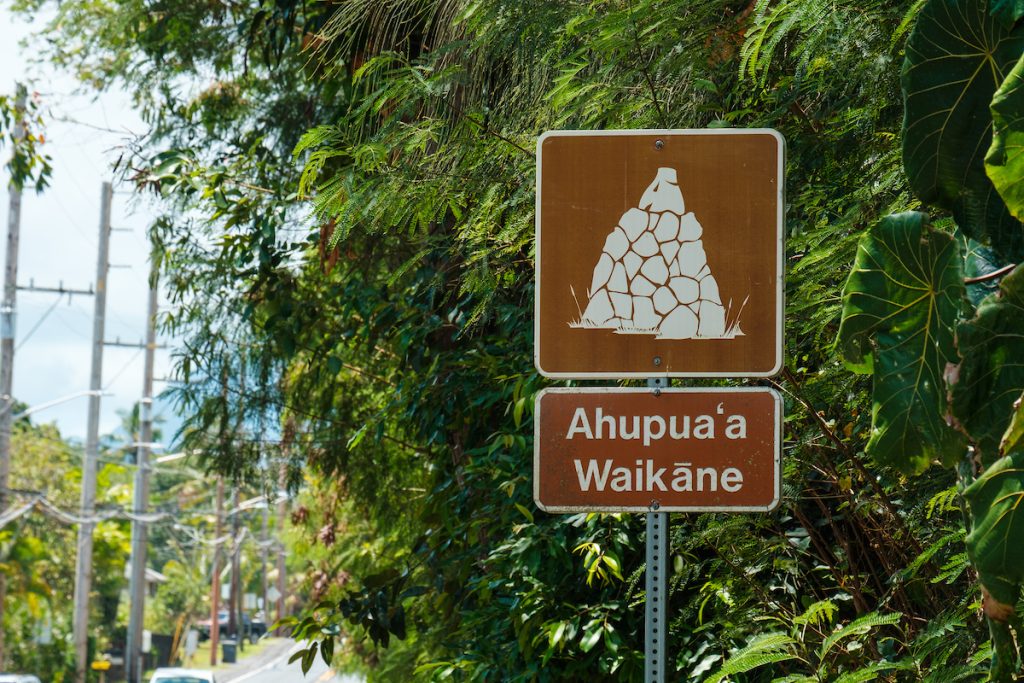
Photo: Aaron K. Yoshino
The idea started when Mahealani Cypher, who volunteers with the Koʻolau Foundation, and Leialoha “Rocky” Kaluhiwa, president of the Koʻolaupoko Civic Club, were sitting at Windward Mall and overheard a group of teenagers talking about where they lived.
“We noted that they were giving incorrect names for the ahupuaʻa that they lived in,” Cypher says. That prompted the pair to pursue grants to fund a project that marked the ahupuaʻa in Windward Oʻahu. “Our goal was to set the foundation for future projects in ahupuaʻa stewardship by marking the boundaries, which would inform residents, businesses and others in each ahupuaʻa about their kuleana to take care of where they live and work.”
The Oʻahu project inspired civic clubs on neighboring islands to do the same. Kauaʻi was the first to launch a similar project, marking only moku (not ahupuaʻa). The Maui Nui Ahupuaʻa Project installed its first sign in the Kīhei area in October 2019.
This story was originally published in our FALL 2022 issue. Subscribe and get HAWAIʻI Magazine delivered to right to your mailbox.
Catherine Toth Fox is the former editor of HAWAIʻI Magazine and continues to contribute to the website and print publication.